Cart
Sub-Total: $0.00
$695.00
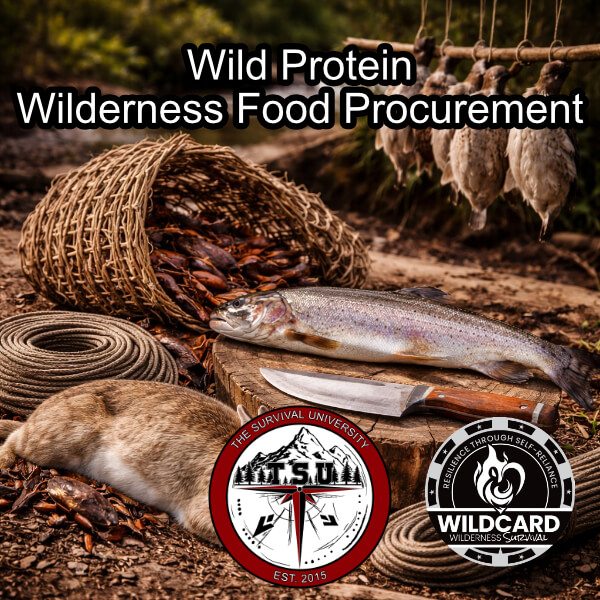
In a survival situation, plants can keep you going, but protein changes the game. This 4-day field course focuses on practical ways to put meat back on the table using time-tested methods. Students will learn to build fish basket traps, crawdad traps, primitive fishing systems, and various traps and snares while also exploring basic animal tracking and a small introduction to wild edible plants. The class focuses on practical construction, field demonstration, and real-world application so students leave knowing how to gather protein from the landscape using simple materials and clear thinking.
Imagine you have been in the field for several days.
You have water. You have a shelter. Maybe you have managed to gather a few edible plants. But your body is starting to feel the difference between simply eating something and actually fueling yourself. This is the point where many survival situations begin to change. Calories matter, but protein and fat begin to matter even more.
For thousands of years, people solved this problem by learning how to harvest animals from the landscape around them. They built traps. They studied animal movement. They learned how rivers, ponds, and shorelines could quietly feed them if they understood how to work with the environment instead of fighting it.
This class explores those skills.
During this 4-day field program, students will focus on practical methods for procuring animal protein in a wilderness setting using simple materials and time-tested techniques. The emphasis is not on gadgets or complex gear. The emphasis is on understanding how animals move, how waterways concentrate life, and how simple systems can do the work for you once they are properly built and placed.
Students will construct and learn to use a variety of traditional systems including fish basket traps, crawdad basket traps, primitive fishing techniques, and several styles of traps and snares designed for small game. Because Colorado law does not allow live trapping in this type of setting, students will not be setting traps for animals. Instead, the course focuses on construction, demonstration, placement strategy, and understanding the behavior that makes these systems effective.
Students will also spend time looking at basic animal tracking concepts that help you recognize where animals travel and where a trap or snare might be placed. When you begin to understand how animals move across the landscape, the entire environment starts to make more sense.
While the primary focus of the course is animal protein, we will also briefly explore wild edible plants that can support food gathering in the field. The goal is to help students begin thinking about food procurement as a system rather than a single skill.
By the end of the class, students will have hands-on experience building multiple trapping systems, working with primitive fishing methods, understanding basic tracking indicators, and learning how to read the landscape for food opportunities that many people walk past every day.
This is a hands-on course designed to reconnect people with the deeper skills that once kept families fed for generations.
Additional Details – Product Details
Course Name: Wild Protein Food Procurement
Location: Mountain Camp, Colorado. 9,500 ft elevation in a mixed pine and aspen forest on private land.
Schedule: 9:00 AM to 5:00 PM each day
Duration: 4 Days
Approach: Hands on training, field based learning, practical food procurement skills
Instructor Type: Guest Instructor
Driving Directions: [Click here for directions]
Address: 71 Monarch Dr, Cripple Creek, CO 80813
Important: Our camp is remote and GPS is often unreliable. Please read the driving directions carefully and save or print them before leaving. Cell service becomes limited once you head into the mountains.
Class Details
Accommodations
Students may camp on site or stay in nearby towns. Cripple Creek is 15 minutes away and Woodland Park is about 30 minutes away. Students arrange their own lodging if they choose not to camp.
Sleeping Arrangements: Students are responsible for their own overnight shelter such as a tent, camper, hammock, or tarp setup.
Facilities: Porta potty restroom and potable water provided.
At camp, a central fire ring and several designated areas are available, with dispersed camping as the primary option. Vehicles can typically be parked within 100 feet of camp.
Food and Water
Potable Water: Available at camp.
Food: Students must bring their own food.
Quick meals such as freeze dried backpacking meals or MREs are recommended because they are fast to prepare and allow more time for instruction. Students may also bring any food they prefer to cook over a campfire or personal stove.
Local grocery stores and restaurants are available in nearby towns if additional supplies are needed.
Gear List
Core Field Tools
Fixed blade knife (full tang, plain edge recommended)
Foraging pouch or small collection bag
Small backpack or daypack
100 feet of cordage such as 550 paracord
Notebook and pencil
Shelter and Sleep
Tent, tarp, or hammock
Sleeping bag and sleeping pad
Rain gear or poncho
Cooking and Water
Metal pot or cup
Eating utensils and small bowl or plate
Single wall metal water bottle or canteen
Meals and snacks
Clothing
Non cotton outdoor clothing layers
Wicking base layer
Insulating mid layer
Waterproof outer layer
Outdoor boots and wool socks
Warm hat and gloves
Sunglasses and sunscreen
Bandana or shemagh
Lighting and Miscellaneous
Headlamp with spare batteries
Personal first aid kit
Optional Comfort Items
Camp chair or stool
Extra snacks or comfort food
Camera or phone for photos
-
Select options This product has multiple variants. The options may be chosen on the product page
-
Select options This product has multiple variants. The options may be chosen on the product page
-
Select options This product has multiple variants. The options may be chosen on the product page
-
Select options This product has multiple variants. The options may be chosen on the product page
-
Select options This product has multiple variants. The options may be chosen on the product page
-
Select options This product has multiple variants. The options may be chosen on the product page
-
Select options This product has multiple variants. The options may be chosen on the product page
-
Select options This product has multiple variants. The options may be chosen on the product page