Cart
Sub-Total: $0.00
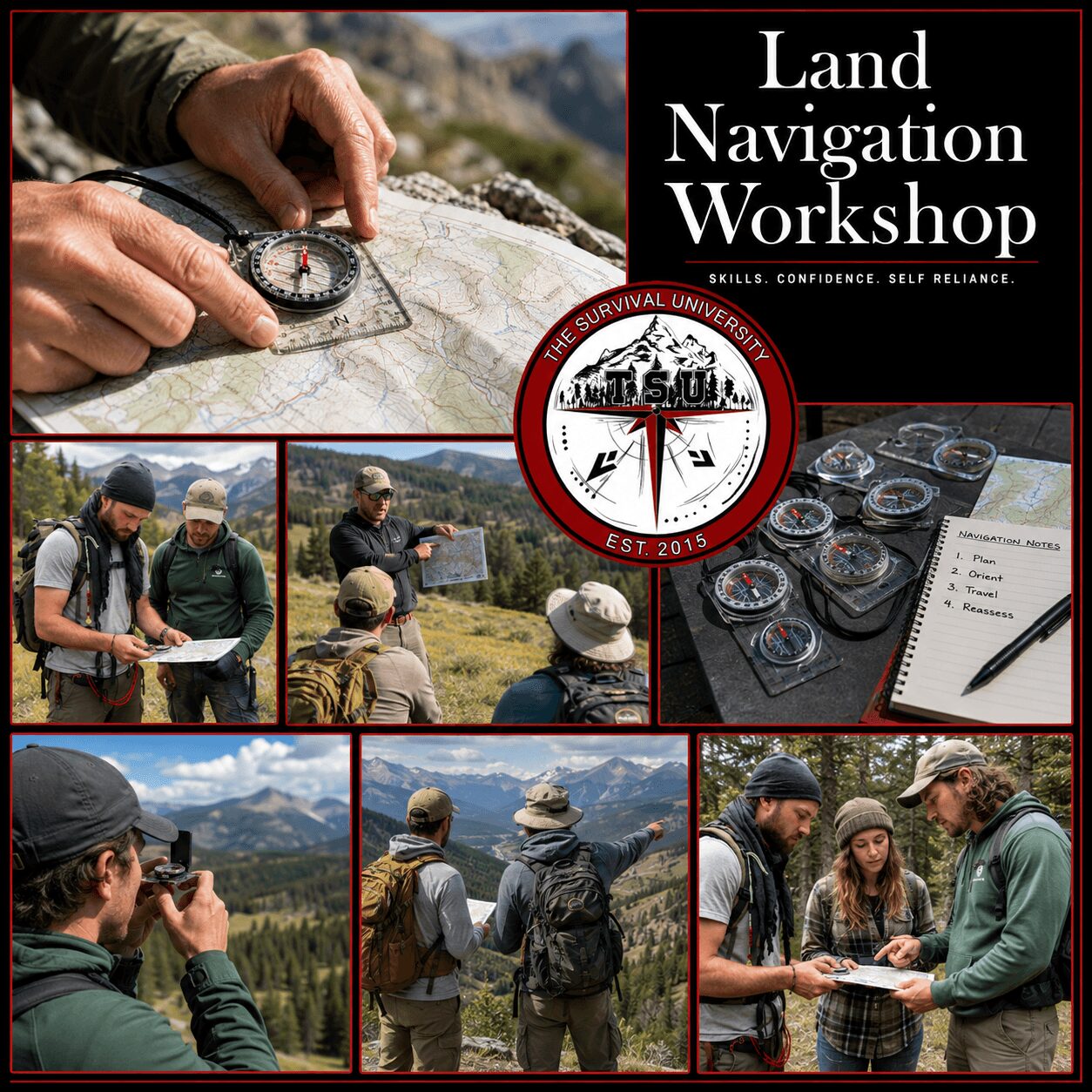
This hands-on Land Navigation Workshop introduces the fundamentals of navigating with a topographic map and compass. Students will learn how to understand contour lines and terrain features, orient a map, take and follow basic bearings, estimate distance, and work through guided navigation exercises in the field. The workshop is designed to make traditional navigation easier to understand while giving students practical experience with the tools and techniques used to stay oriented outdoors.
Learn the fundamentals of traditional land navigation using a topographic map and compass. Students will practice reading contour lines and terrain features, orienting a map, taking basic bearings, estimating distance, and completing guided field exercises.
Arrive by 9:00 AM for check-in. Class begins at 10:00 AM. Plan your drive so you are at the meeting location one hour before instruction begins.
This workshop is held at The Survival University’s Mountain Campus outside Cripple Creek, Colorado. Click the location link below for the exact campus entrance and driving directions.
Potable water will be available at the Mountain Campus. Students must bring their own lunches, snacks, and any additional drinks they would like during the workshop.
Bring food that can be eaten quickly so we can spend as much time as possible working with maps, compasses, and field exercises.
Orienteering compass
We recommend the Suunto MC-2 Navigation Compass or an equivalent quality orienteering compass.
Phone compass apps, button compasses, and inexpensive novelty compasses are not suitable for this workshop.
Small backpack or daypack
Sturdy hiking boots or trail shoes
Layered outdoor clothing appropriate for mountain weather
Rain jacket or poncho
Headlamp with extra batteries
Sunscreen and sunglasses
Lunch, snacks, and personal drinks for both days
Refillable water bottle
Any necessary personal medications
Pace beads or ranger beads
Lightweight gloves
Gaiters for wet grass or brush
Map case or large zip-top bag for protecting maps
Insect repellent
Weather at the Mountain Campus can change quickly. Dress in layers and bring clothing suitable for sun, wind, rain, and cooler temperatures. Cotton clothing is discouraged. Wool and synthetic materials perform better when conditions become wet or cold.
Weather, terrain conditions, and the experience level of the group may require instructors to adjust individual exercises. Every effort will be made to provide a consistent, practical, and valuable training experience.
Ultra-fine-point permanent map markers
Staedtler Lumocolor or equivalent.
Maps and other instructional materials used during the workshop will be provided.
-
Select options This product has multiple variants. The options may be chosen on the product page
-
Select options This product has multiple variants. The options may be chosen on the product page
-
Select options This product has multiple variants. The options may be chosen on the product page